Superstaff™
Preparing your musical experience...
Preparing your musical experience...
A story of necessity, discovery, and a new way to learn music.
Have you ever heard the expression “Necessity is the mother of invention”?
My story is a perfect example of that truth. Once you read it, you can decide for yourself.
Date: 2001
While composing obbligato passages with very high pitches for a handbell choir, I became increasingly frustrated with the constant use of ledger lines. Writing and reading these passages was slow, cluttered, and unnecessarily complicated.
To solve this problem, I began experimenting by drawing continuous solid lines in an effort to simplify pitch notation.
(Example #1 shows pitches that fall outside traditional Grandstaff limitations and require multiple individual ledger lines. Even the keyboard below reveals that the Grandstaff cannot name all the pitches we need.)
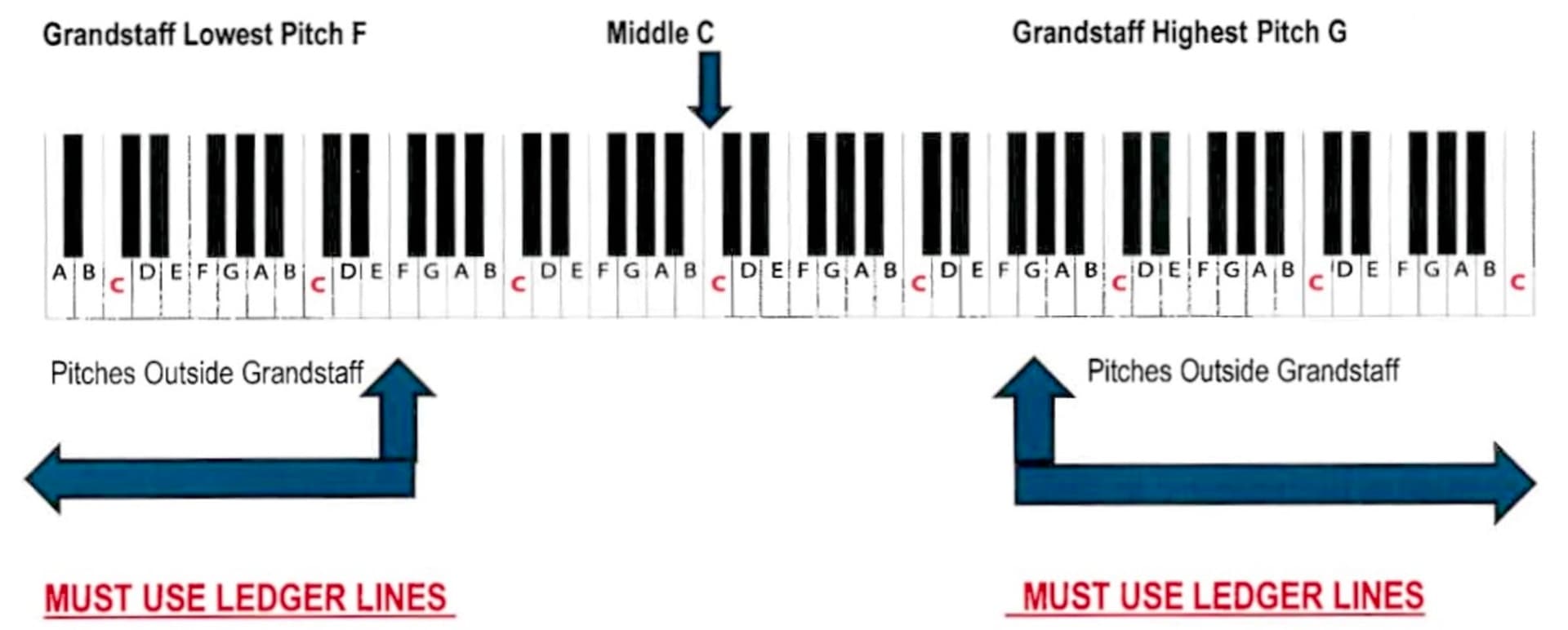
At first, this approach did make writing easier. But the true epiphany came when it became apparent that by incorporating the treble ledger line “A” and the bass ledger line “E”, something extraordinary happened.
The staff spelling changed — and both staves became identical.
Both staves now read:
E G B D F A
From an educator’s perspective, this was a revolutionary breakthrough.
Learning pitch names for two different staves has always been a major stumbling block for new musicians. In the traditional Grandstaff:
Two hurdles. Two spellings. Twice the confusion.
With Superstaff™, that barrier disappears.
I was excited by this discovery and determined to share its validity with other educators.
Another important by-product of the Superstaff™ Music Staff Paper became immediately obvious. The spelling of the lines — E, G, B, D, F, A — was not only consistent across both staves, but both key signature patterns also became identical.
This led to another remarkable realization:
By combining two treble staves and two bass staves, every sound in every register had a clear staff placement.
WOW.
This meant that countless promising musicians — many of whom had given up on music because it felt too difficult or overwhelming — could now learn pitch reading by mastering one single pattern of lines and spaces.
One pattern. Clear logic. More musicians.
I began sharing the concept with professional colleagues.
Results: Nearly everyone agreed the idea was “interesting and had real potential.”
The most common question was:
“How do we transition from the Grandstaff to Superstaff™ Music Staff Paper?”
My answer was simple:
We use both systems.
There was no need to change, edit, or rewrite existing manuscripts. Musicians already understand ledger lines — Superstaff™ simply extends that knowledge.
Every colleague strongly suggested that I protect the concept.
I began the process.
The concept was presented to a Cleveland-based patent attorney for evaluation regarding eligibility for a patent application.
Results: After months of research, his team uncovered eleven prior patents granted for various “music reading systems.”
The patent application process began, but in 2005 the application was denied. The examiner stated:
“Music systems in general are not patentable.”
This decision stood despite the existence of numerous music-system patents already on file with the U.S. Patent Office.
While disappointing, this outcome did not discourage my determination to introduce a more efficient and effective music reading system.
I began securing written permission from music publishers to transcribe existing musical selections from the traditional Grandstaff into Superstaff™ Music Staff Paper for demonstration purposes.
Results: Multiple permissions were granted, and transcription work began.
Superstaff™ was accepted by OMEA as an On-Site Clinic.
During the presentation, attendees were given simple original piano pieces and asked to play them first as written on the traditional grand staff, and then again as transcribed into Superstaff™ Music Staff Paper.
Results: Participants were able to adapt easily to the Superstaff™ concept.
The younger the participant, the more readily adaptable they were.
However, one issue became clear:
The solid extra line caused confusion.
Conclusion: The solution was to make the “A” and “E” lines continuous ledger lines, rather than solid staff lines.

I began conducting handbell workshops with ringers who were asked to sight-read one musical sample first on the traditional Grandstaff, and then on Superstaff™ Music Staff Paper.
Participants completed questionnaires regarding the ease of music reading using both systems.
Results: Survey responses were overwhelmingly positive. The more experienced the musician, the higher the scoring for Superstaff™ Music Staff Paper.
Participants were multi-generational and represented a wide range of musical experience.
I was accepted as a presenter at the Handbell Expo in Hershey, PA, where I conducted a workshop titled “No More Ledger Lines.”
Participants repeated the workshop format: sight-reading, performing, and completing surveys.
Results: Performance ability improved, survey answers were positive, and many participants expressed enthusiasm for the concept.
Following advice from colleagues, I conducted a pilot study with elementary students focused on music reading using Superstaff™ Music Staff Paper.
I contacted The Ohio State University graduate program and partnered with a Ph.D. student to design and complete the study.
The completed study was submitted to the Society for Music Education as a presentation proposal for the 2010 Music Educators National Conference in Anaheim, CA.
Results: The study was accepted as a Poster Presentation at the MENC Conference.
Attendees were introduced to the Superstaff™ concept and provided literature outlining the study and its findings.
The study concluded that learning to identify the names of the lines on a staff was more easily achieved using Superstaff™ Music Staff Paper.
The concept was met with strong interest and was readily understood by attendees.
The Superstaff™ Music Staff Paper concept was introduced to Finale music notation software, exploring the ease of application within existing music-writing platforms.
Results: Finale confirmed that Superstaff™ Music Staff Paper could easily be offered as an option alongside the traditional Grandstaff, and that both systems could be used interchangeably within the same musical selection.
I began collaborating with a music colleague to write a sample curriculum as an introduction to the Superstaff™ Music Staff Paper System.
This work is ongoing.
The Superstaff™ trademark was granted, and the website was launched. A pilot study involving 300 fourth-grade students across three Ohio schools is scheduled for Fall 2026 using the Superstaff™ Curriculum Workbook.
I have been blessed to call myself a musician. The most meaningful and inspiring moments of my life have been centered around the indescribable joy of teaching, composing, listening to, and performing music. I know this world is a better place in a musical setting. Musicians are happy people, because our music gives our spirits wings. I will continue to help others eager to fly.